Sunday, March 14, 2010

Gentleman John's son, the wearer of Miss Daly's dress, a continental painter and the great melodist

You know you're on a journey when you read that the subject was "eldest of the four illegitimate children of Lt-gen. 'Gentleman' John Burgoyne". Gentleman John isn't in the DIB (he's in the Oxford DNB), although his military career took him briefly to Ireland; as a soldier, he is chiefly famous for having commanded the British force that surrendered at Saratoga during the American revolutionary war. He was gentlemanly enough to father his illegitimate children by the same woman, the singer Sarah Caulfield, and to wait until his wife was dead to do so. He was in his 60s, and had switched from the military to a career as a playwright. After his death, his brother-in-law, the Earl of Derby, provided for the upbringing of the four children, including our DIB entry, Sir John Fox Burgoyne, who had a career as a military engineer, based in part in Ireland. (This Derby is the Derby who gave his name to the Derby of horseracing.) Burgoyne was in charge of administering the soup kitchen scheme introduced during the great Irish famine, which briefly provided some form of - barely adequate at best - nutrition for up to three million people but which was swiftly phased out.

Less gentlemanly but perhaps more interesting is John Daly Burk, who crammed a lot into his 36 or so years. He was expelled from Trinity College Dublin for blasphemy (he was a deist) and wrote a defense, The Trial of John Burk (available online for those, not alas including me, who belong to a subscribing library), in which, according to the DIB, he "compared his persecution to that of Priestley, Galileo and Socrates." He moved in radical circles in Dublin, and escaped arrest by decamping from a bookshop surrounded by soldiers in the clothes of a Miss Daly, whence his middle name, adopted in gratitude. (The more I think about that story, the less I believe it). On his way to America, he wrote a play, Bunker Hill, or the Death of General Warren, which according to the DIB was regularly staged on July 4 for over 50 years and made Burk much money, despite bad reviews (one critic appoved only of the fact that it was short). He also wrote an epic on the revolution titles The Columbiad (not to be confused with the Joel Barlow poem of the same title), which remained unpublished ("bombastic and poorly-written", says the DIB), although Burk thought highly enough of it to send extracts to Thomas Jefferson, to whom he later dedicated his History of Virginia. In America, he seems to have been on the better side of most issues: against the alien and sedition acts, anti-slavery, for humane treatment of the Indians, and so on. However, he couldn't prevent himself from living to extremes: he was kicked out of his job as a college principal for adultery, was ordered to leave the United States after being accused of sedition (he didn't, but hid out in Virginia) and finally died in a duel following a row in a tavern: he insulted France, and a Frenchman called him out and shot him.

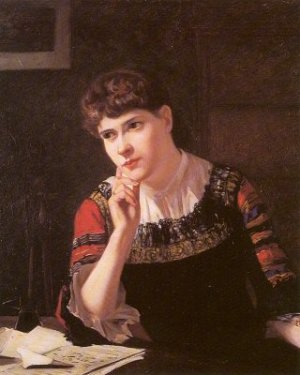
Augustus Nicholas Burke was a painter from Galway. He was only around 25 when he first exhibited at the Royal Academy in London. When he was about 30, he moved to Dublin with his artist sister Dorothy (the subject of this portrait) where he became a successful landscape artist and portraitist. In the late 19th and early 20th centuries, many Irish painters were drawn to the north Atlantic coastline of mainland Europe: Brittany, northern France, Belgium and Holland. Burke was one of the first, and in his later role as professor of painting at the Royal Hibernian Academy, may have encouraged others to do the same. His brother, Thomas Henry Burke, was the leading civil servant in Ireland and was assassinated by a nationalist group, The Invincibles, in Dublin in 1882. Augustus was devastated by his death and left Ireland shortly afterwards, living in London and Italy. He is buried in the English cemetery in Florence. He was a rather fine, if academic and occasionally sentimental painter. A wide selection of his work can be found here.

Edmund Burke is of course one of the truly phenomenal Irish figures of the 18th century, as philosopher, pamphleteer and politician, and accordingly rates a huge entry in the DIB of more than 6 pages, by Eamonn O'Flaherty. I've noticed before that academic historians tend to be rather sniffy about Conor Cruise O'Brien's wonderful portrait of Burke, The Great Melody: it's not mentioned in O'Flaherty's bibliography. O'Brien never wrote anything without an axe to grind, so of course his account is partial, speculative and tendentious. It's also fabulous, including close readings of Burke's writings that are constantly informed by the shrewd intuitions of both the critic and the politician that O'Brien was. (I may say more about O' Brien at some other time - his death was too late to qualify him for the DIB. At this stage, I'll simply say that I'm an admirer, but by no means an unqualified one. I'm fiercely critical of some of his actions in government, as well as some of the political positions he took, particularly in his later life. But I hugely like his book on Burke, warts and all.) W.B. Yeats, in his poem The Seven Sages, had written of the "great melody" of Burke's lengthy and laborious campaigns over America, Ireland, France and India, and O'Brien picked up on the lines to support his conviction of a "profound inner harmony" embracing Burke's approach to these subjects.

O'Brien sees Burke fundamentally as a product of Catholic Ireland, of the Norman gentry that was progressively gaelicized and which by the 18th century, when laws acted as barriers to catholic advancement, was faced with the challenge of how to maintain its declining positions and to compete with the protestant gentry. O'Brien argues that Burke's father, Richard, "conformed" to the established protestant church in order to maintain his practice as a lawyer. (O'Flaherty notes this as merely a possibility, although O'Brien's archival researches on the question seem to have been quite thorough.) His mother, Mary Nagle, remained a catholic, and Burke's early upbringing at home until the age of 11 was, O'Brien believes, in a catholic environment; this ended when he was sent to a quaker school in order, it is argued, to prepare him for entry to the protestant world and the advancement that would be possible for him there. (He also married a catholic.)

One consequence of this experience, according to O'Brien, led Burke  to detest the arbitrary exercise of power. This visceral, personal impulse is the strand that ties together his attack on anti-catholic laws in Ireland, his defense of the rights of the American colonists, his onslaught against the excesses and corruption of the East India Company, and his recoil from the violence of the French revolution.

I first encountered Burke at school, where perhaps naturally I was less impressed by his Reflections on the revolution in France, than I was by its riposte, Thomas Paine's The Rights of Man. Temperamentally, as well as politically, I think I still side with Demos against Basileus, but there's no question - and subsequent events everywhere confirm this - that revolt in the name of abstract ideas tends, perhaps inevitably, towards the victimization of thoughtcrime and the institutionalization of new tyranny. Later, as a student, I was very taken with his Philosophical Enquiry into the Origin of our Ideas of the Sublime and Beautiful, which I was advised to read as an entry-point to the understanding of the gothic in literature and art; shorn of its ultimate grounding in God's providence, its psycho-cultural analysis of the vying influences causing pleasure and fearfulness is an antecedent to Freud's opposition of eros and todestrieb/thanatos.  Once one follows O'Brien's fundamentally psychological view of Burke, it is hard not to read into this opposition another key conservative anxiety, at the fissure between culture and anarchy, or between order and oppression.

Thus, Burke saw the enactment of progressive catholic relief laws both as justifiable in itself and as a means of staving off revolutionary elements in Ireland - elements, that of course revolted in 1798. He denounced coercion of American colonists both because it was wrong in itself and would have undesirable political outcomes. He attacked the East India Company (in its day, an even more powerful Halliburton or Blackwater) both because its treatment of India was intrinsically wrong and because its actions injured the British imperial interest in the subcontinent. And his strictures on the French revolution, while foreseeing its descent into tyranny and terror, were also aimed at the geopolitical consequences of so significant an upheaval in a great power.

I think that, ultimately, the reason I can't join the Burke cheering section, at least not wholeheartedly, is because, despite the fact that he about as principled politician as you can get, he was, au fond, a politician. He wanted to preserve the empire and could not comprehend that the very idea was fundamentally despotic. I think that Irish writers such as O'Brien, who quite rightly turned away in horror from the terrible violence of the troubles, wanted to posit an alternative history, whereby Ireland would have evolved painlessly into a modern nation-state, part of the empire/commonwealth, in the same manner as such other white "kith and kin" republics as Australia, Canada and New Zealand. Such a view allows for the rejection of the entire "physical force" tradition, dating back at least to 1798, and maybe further. It attacks the undoubtedly self-serving mythologizing that at times evolved into "undisputed historical facts" in recounting elements of the movement for independence. Burke's foresight, intelligence, restraint and conservatism seems superficially to stand against the "bad" Ireland for the "good" (if imagined) one. I'm not so sure. As O'Flaherty points out, in the tense times of the 1790s, when fear of French revolutionary contagion pushed the British government towards repression, Burke supported firm action against domestic radicals and opposed increased toleration of unitarians - laws discriminated against groups that denied the holy trinity in ways similar to discrimination against catholics - suggesting pragmatic limits on his embrace of liberty. He was also strident in his calls for war with France a strategy that arguably led to the domination of Europe by Bonaparte, domination that was only finally undone, after more than 20 years of conflict, by imperial overreaching and then, only thanks to what Burke's fellow Irishman the Duke of Wellington called "the nearest run thing you ever saw in your life", as he described the battle of Waterloo. If you want to get counterfactual, you can enlist Burke for a bad version of history as well as an ideal one.

O'Flaherty concludes of Burke: "Central to all of his concerns was a political theory founded on a combination of pragmatic justice - utilitarian in the tradition of natural law - and a belief in the historical evolution of human society." The first strikes me as inherently suspect: one person's pragmatism is another's self-serving justification. The second is really a fantasy: that the permanent lurches and upheavals of life can be smoothed over by benign forces. The problem with this is that one usually doesn't get to control these forces, and whoever does tends to have motives that are less than benign. So, either as an exemplar of an imagined Ireland, or a founder of certain conservative traditions, these proposed Edmund Burkes don't really persuade me. But he's fascinating and always worth revisiting: one for the ages, if not the pantheon.

Saturday, March 13, 2010

The source of bunburying, the harp antiquarian, an expensive architect and the first of the De Burghs

Selina Bunbury is one of those writers you've never heard of who turn out to have been quite important in their time. She published more than 100 books. A few have come back into print through public domain publishers and there's been some academic study of her, but I doubt she'll be a big rediscovery. She wrote like this:
In the gloomy turret-chamber of a strong tower, near to the coast, lay a wounded English knight who, after having won his spurs by early and valiant service with the noble Sir Philip Sidney, and afterwards with the gallant Essex, was reduced to the sad mortification of having had not only his life endangered, but his good looks, for the time at least, very seriously damaged, by the rude stroke of an Irish club.
Much more of that, and you'd want to take a rude stroke of an Irish club to Selina. I only mention her at all because of her surname, and its connection to a bettter Irish writer, Oscar Wilde. In The Importance of Being Earnest, "bunburying" is, of course, the diplomatic excuse for leaving town, on account of the illness or near-death of a friend called Bunbury. While there's a story that the so-called "wickedest man in the world", Aleister Crowley, claimed that Wilde had coined the word through a conflation of the English towns Banbury and Sudbury, it seems far more likely that he was well acquainted with the name, which is not particularly uncommon in Ireland (it has Norman roots). Wilde's fabulous mother Speranza was very well plugged into the Irish literary scene and it seems improbable that Oscar would have been unaware of Selina, or of the mellifluous name on which he conferred immortality.

By the early part of the 19th century Edward Bunting, from Armagh, was already a prominent musician, church organist, piano teacher and performer. He had become fascinated by the Irish harp through his participation in the Belfast Harp Festival in 1792, whereupon he traveled around Ireland collecting tunes which might otherwise have been on the verge of extinction. He published three collections of the "ancient music of Ireland", all of which are miraculously available, for free, on the internet. He tussled with Thomas Moore over the political significance of traditional Irish music but above all preserved the best for all of us. Derek Bell's recordings of the great blind harpist Turlough Carolan, whose work Bunting notated extensively, are sublime examples. I also found a nice harp version of a Carolan piece here.

And with Edward Bunting, I end the first volume of the DIB. 'Flu has pushed me quite far behind schedule, but it's not as if these lives are going away. I turns out that volume 1, at 989 pages, was just a minnow. Step forward volume 2, a muscular 1148 pages! Much work to be done.

It's not explained in the DIB what "legal reasons" prevented the burial at St. Fin Barre's Cathedral, Cork of its architect, William Burges, and I'd really like to know. He won a competition for the commission in 1863; even though the cost of building the cathedral was capped at £15,000: not unusually for major architectural works, the actual building vastly overran its budget, and eventually cost more than £100,000. Burges, who was English and a leader of the gothic revival, sounds like a sympathetic figure: he dressed like a medieval architect, liked pubs that mounted rat hunts (maybe not so sympathetic) and "often greet[ed] his friends with a parrot on either shoulder" (not sure if this means one parrot alternating shoulders or two, split between each shoulder). Even though he didn't get his funeral in Cork, there was a memorial service: according to the DIB, all the church bells were silent on that day.

I imagine that when William de Burgh was en route to Ireland in 1185, bent on conquest and the acquisition of more wealth, at both of which he proved very successful, he little imagined that 800 years later his direct descendant would become famous for composing and performing Patricia the Stripper, surely one of the most dismal attempts at commercial salaciousness of all time. Chris de Burgh isn't in the DIB, although I suppose he will be one day, but there are plenty of William's direct and indirect progeny - de Burghs, de Burgos, Burghs, Burkes and the like - to take us through 74 pages of volume 2. A lot of them were in the conquering and subduing business, and tend to merge together in my mind. But there are some other pleasures to be found, among them Thomas Burgh, a military engineer and architect, who built the magnificent library at Trinity College, one of those sights that all guide books steer you to see but which never disappoints. He also wrote a book on how to measure the areas of rectangles. (I thought you multiplied one side by the other, but it's obviously more complicated than that.)

Friday, March 12, 2010

The "moron" bishop, the bishop's antagonist, another botanist and the spycatcher

Michael Browne was catholic bishop of Galway in from 1937 to 1976 and seemed to exemplify everything that was wrong with the church. (I meant to write about him a couple of entries back, but overlooked it: he's accordingly a little out of alphabetical order.) He was among those who led the hierarchy's objections to Noël Browne's mother and child health scheme. He supported a boycott of protestant businesses in Co. Wexford during a dispute over a protestant woman married to a catholic man who refused to educate her children at the local catholic school. He described Trinity College Dublin as "a centre for atheist and communist propaganda". He forced the segregation of the sexes on Galway beaches. He seemed so perpetually angry that his episcopal signature - "† Michael" - was popularly rendered as "Cross Michael". He supervised the construction of a grandiose new cathedral in Galway that local wits dubbed the "Taj Micheáil" (pronounced Meehaul). And it was in connection with the Taj that my life path ever-so-slightly crossed with that of Michael Browne.

In 1966, my father appeared on The Late Late Show, a very long-running Saturday-night TV show that became an outlet for all sorts of discontent in Ireland. My dad contributed to a discussion of popular radio and TV series, one of which he wrote. After he'd left the stage, the real fun began (I was allowed to stay up to watch). A Trinity College undergraduate named Brian Trevaskis said some very rude things about Bishop Browne and his cathedral: one of the words he used was "moron". All hell broke loose - saying even politely critical things about the church was rare in public discourse in those days, and invectve virtually unknown. The papers were full of back and forth for days, and eventually Trevaskis returned to The Late Late Show to apologize. I was allowed to stay up and my memory is that Trevaskis cut a very unimpressive figure to my young eyes and ears - I basically thought he sold out, like Mick Jagger singing "Let's spend some time together" on Ed Sullivan. The record seems to suggest that Trevaskis wasn't as abject as I recall, and that he was quite rude again to Browne.

Of the two, Trevaskis turns out to be the more interesting figure. In 1966, he was quite an old undergraduate (26 or 27) and, contrary to the image of the Trinity student of the time, was both catholic and working class - he had been raised for at least part of his life in an orphanage. He became president of the Trinity debating society, the Phil, and wrote a couple of plays. He also failed his English exams and had to leave. My old undergraduate tutor, Nick Grene, who now has a chair at Trinity and who performed in Trevaskis' plays, kindly provided some memories of him:
Brian was a quiet spoken, heavy-set man with a red complexion, who was bent on defying all the orthodoxies. He supposedly failed his English exams because he determined to go to the zoo rather than attend the Anglo-Saxon exam, which he regarded as a waste of time; unfortunately he mixed up the timetable and therefore missed another of the literature papers, thereby failing more of the year than was acceptable.
In the wake of this setback, he moved to Cornwall (Trevaskis is a Cornish name), joined the church of England, went for a while to Bristol University, and eventually returned to Ireland. He engaged constantly in controversy; attacked, for instance, the celebrations of the 50th anniversary of the Easter rising in 1966, the inability of the Irish in Britain to vote in elections back home, the decision of the Abbey Theatre to stage a play by Boucicault that he deemed to be paddywhackery, and dubbing the ruling Fianna Fáil party "neo-fascist". He was hit by a train in north Dublin in 1980, and died. I've read accounts that he committed suicide, but have been unable to confirm these. He seemed to me in the spring of 1966 - I was not yet 9 - to be intelligent, articulate and very angry. As Nick Grene wrote to me: "I was very sad to hear of his later life and death: a waste of energy and talent." Bishop Browne had nothing to do with the death, but he was in a way part of the Ireland that Trevaskis couldn't live with. The old Ireland, I think: it all seems much longer ago.

I've found that I have a weakness for botanists. Here's another: J.P. Brunker worked for the Guinness brewery and spent weekends in Co. Wicklow, studying the local flora. After 30 years of what the DIB describes as "tramping", he published his master work, The Flora of the County of Wicklow (his DIB entry omits the second "the" and the "of", but I think that may be incorrect). He also contributed to a catalogue of the flora of Co. Dublin. I'd imagined that all of this sort of work had been completed in the 18th and 19th centuries, but it's clear there was still plenty to be done in modern times. Brunker died aged 85 after being injured by a car while conducting field work. I imagine he was descended from Sir Henry Brouncker, an Elizabethan soldier in Ireland I encountered a while back but didn't write about. Sir Henry was so zealous an anti-catholic that even the English privy council told him to tone things down. I'm glad his later relatives were given to gentler pursuits.

For quite a while, we've known about the attempts of German intelligence to place spies in Ireland during the Second World War. There was quite a good miniseries about it in 1984 called Caught in a Free State, which to my recollection depicted the nazi efforts as somewhat hapless, and the attempts of certain IRA elements to engage with them - the usual my-enemy's-enemy-is-my-friend stuff - as close to comical. Hapless, or not, they were spying in a neutral country, and thanks to the Irish intelligence service, G2, headed by Col. Dan Bryan, all 12 nazi spies in Ireland were identified and arrested by the end of 1943. Bryan, with the knowledge of the Irish government, cultivated close relations with British intelligence and exchanged extensive information with it: this did not prevent him from successfully recruiting an informant in the British intelligence operation in Ireland, whose activities he was able to monitor until the end of the war. One of the reasons Bryan was able to roll up the German spy ring was in part because he recruited a librarian-cryptographer, Richard Hayes, who cracked the code they were using. This success was initially withheld from Bryan by subordinates, who believed he would provide the information to MI5. When he got it, he did. Ireland's neutrality caused it serious political and diplomatic problems which the intelligence cooperation was intended to relieve. Unfortunately, even senior figures were unaware of what was happening in the secret world: I've previously written of how Irish diplomacy had to try to overcome the negative impact of the attacks on Irish policy by the wartime U.S. ambassador, David Grey. Bryan's own operation was rolled up at the end of the war, which distressed him no end.

Wednesday, March 10, 2010

Two Patrick Brownes, an impressionist photographer and the hardest of the hardliners

Anti-catholicism was a constant issue for England from the time of the break with Rome in 1534. In Ireland, there was always a geopolitical aspect - fear that the recalcitrantly catholic Irish would make common cause with their co-religionists in Spain, and later France, and threaten England's western flank. It took 150 years for England - later, Britain - to subdue catholic Ireland through war and confiscation, followed by nearly the same amount of time during which catholics were subject to civil penalties of varying degrees of severity. The human dimensions of these policies are easily lost behind the sheer numbers of people affected, as well as by the many, many private histories that were never written. So, sometimes an exemplary life tells a lot. Patrick Browne was a Dublin merchant, a prominent man who supported the English government and was invited to become mayor of the city. He was also a catholic who refused to conform to the established (protestant) church. He began to be prosecuted for recusancy and was fined and imprisoned. His defiance continued and so did the fines and imprisonment. At one time he was offered a kind of buyout - purchase, presumably for a substantial sum, of immunity from prosecution. He refused. The jailings continued regularly. In 1614, after about 11 years of persecution, he caught an infection in prison and died. It's a small, sad story - the determination of a ruthless sovereign to impose conformity and the refusal to give in. Not being a person of faith, I know I would have paid the money. But I'm moved by Patrick Browne's death, perhaps because he seems to have been more awkward than histrionic: no big speeches or grand gestures, just the constant back and forth between freedom and incarceration until the end came.

There are kinder forms of immortality. Another Patrick Browne has a lovely genus of shrubs and trees named after him, the Brownaea. He was a Mayo doctor who pursued science in the classic 18th century manner, as an exalted hobby. He corresponded with Linnaeus, Joseph Banks and Hans Sloane, and collected the flora and fauna of the West Indies, writing a landmark book The Civil and Natural History of Jamaica (which, thanks to the internet, you can actually read, here.) He also described several hundred plants in Mayo and Galway and urged the establishment of an Irish botanical garden (one was eventually created, in Dublin). As a demonstration of the international reach of these corresponding scientific pioneers, the Brownaeai genus was named for him by the director of the Imperial Gardens in Vienna.

Here's another beautiful thing: an 1870s photograph of the Slieve Bloom mountains in Co. Laois by T.M. Browrigg, a policeman and amateur photographer. He photographed prodigiously for 50 years, exhibiting and winning prizes in Ireland and England for landscapes taken in those countries as well as France, Italy, Spain and Italy. From the 1870s on, he became identified with what were describe as both "naturalistic" and "impressionist" styes, experimenting with focus and paper to varying effects. His pseudonym as "Waterbaby", which cerrtainly fits this photo. He was also quite successful as a policeman, retiring as an assistant inspector-general of constabulary at the age of 54, leaving himself with a quarter-century of time to photograph unencumbered by the demands of paid work.

Cathal Brugha was born Charles Burgess, but like so many gaelicized his name during the politico-cultural fervor of the 1890s and early 1900s, during which he acquired a fluent command of Irish. Fervid, too, was his revolutionary outlook, causing him to leave a job for an English-owned business to set up his own company with fellow nationalists. (The new enterprise also gave him cover to enlist new recruits to the cause while traveling for it as a salesman.) He fought in the Easter Rising and was so badly wounded that the English released him from hospital to die, rather than hold him prisoner as they did so many others. He survived, but experienced considerable pain thereafter. Although he was a central figure in the war of independence, and the subsequent civil war, he has tended to get a bad press from historians. Mostly, his poor reputation has been self-inflicted: he burned with hatred for Michael Collins, resenting his success in and appeal to to the republican movement. He was hard-headed to the point of obstinacy, which even his friends found hard to bear. He died of wounds sustained during the civil war, characteristically fighting on when most of his comrades had surrendered. Ironically, Collins paid him a handsome tribute after his death.

The admiral of 1200 streets, the dead of foreign wars and the natural oppositionist

The DIB doesn't say it, but Wikipedia claims, that William Brown has more than 1,200 streets named after him. I doubt that there's a Calle Guillermo Brown in Foxford, Co. Mayo, where he was born in 1777, but there is a rather nice bust in his memory. He joined the British navy, then shipped out in the merchant fleet, ending up in the West Indies and finally Buenos Aires. With his maritime training, he was hired by Argentine rebels to raid Spanish shipping and found himself in command of 19 ships, which he turned into a navy. He may have brought the fine Irish traditions of splits and begrudgery with him, because although successful in war, he was driven out of the navy, then brought back, then forced to retire, upon which he tried suicide - apparently one of his rare failures. Of course, once the new Latin American states stopped fighting the colonial masters, they started wars with each other. In 1825, Argentina began to fight Brazil and he was called back to service, in which he was again successful. He later fought in a civil war as well as in what a "stupid war" with Uruguay, before retiring to farm. If the story of the 1,200 streets is true, the begrudgers lost comprehensively.

As we've already seen, Irish military types, particularly soldiers, have turned up all over the world. For a while after the country was finally admitted to the United Nations (as a Second World War neutral that had maintained diplomatic relations with Germany, Italy and Japan, it was at first excluded), its small army was frequently put into service in peacekeeping roles. Which is how in 1960 Anthony Browne, not yet 20 from the Fatima Mansions council flats in Dublin, found himself in an infantry patrol in Katanga, which had attempted to secede from the rest of the Congo. Browne was one of more than 6,000 Irish troops who served in the Congo in an effort to maintain the unity of newly-independent state. As often in the fog of war, the details aren't clear. On November 8, Browne was a member of a patrol that entered the village of Niemba to examine a damaged bridge. There, they encountered a group from the Baluba people, who opposed the Katangan secession. They were armed with arrows, some of which were poison tipped, as well as possibly some guns. Gunfire broke out - according to one report, it was the Irish that fired first, but it's impossible to say. Arrows rained down on the Irish soldiers, and eight died, either from arrow wounds or subsequently beaten to death. The Irish fought back and killed around 25 Balubas. Trooper Browne was one of three Irish who survived the encounter, but, cut off from the rest of his patrol, he was killed by Balubas some days later while trying to obtain food. Browne was posthumously decorated for his gallantry in the skirmish, in particular for having endangered his own life while attempting to protect those of others. However, in a strange coda to the skirmish, one of the two survivors, whose life Browne was claimed to have saved, later denied the official army account. (The DIB account glosses over this claim.). The Congo war was a murky one, with elements of a proxy war among Western powers over the country's hugely valuable mineral resources. The war claimed the lives of the revered United Nations secretary general Dag Hammarskjöld and the Congolese leader, Patrice Lumumba, both of whom died in questionable circumstances. Another Irishman in the Congo, Conor Cruise O'Brien, who served as Hammarskjöld's representative in the country, was recalled, he believed, because he opposed an alleged British plan to amalgamate Katanga with its then-colony Rhodesia. Murky times, into which Browne, not yet out of his teens, stumbled. (So alien and remote was the Congo to these cloistered, often ill-educated working class men that there's a story - probably apocryphal - that one soldier's wife believed her husband had been posted to Cong, Co. Mayo, and wondered why she hadn't seen him for six months.) More Irish soldiers died in the Congo, as they did on subsequent UN missions in Cyprus and Lebanon. Let's hope they did some good.

Noël Browne was one of the really interesting Irish politicians in the period following independence. He was a doctor who came from a family that had been ravaged by that great scourge of the pre-antibiotic days, tuberculosis: his father, mother and older brother all died of it, and he himself was a sufferer. It was his zeal to eradicate tuberculosis in Ireland that drove him into politics in 1948, as a member of the newly-formed Clann na Poblachta, a left-leading nationalist political party. Elected in Dublin, Browne joined an unwieldy coalition of Fine Gael, Clannn na Poblachta and several other parties as minister of health, from which position he launched a wide-ranging and largely successful anti-tuberculosis campaign, funded substantially by the legendary Irish Hospitals Sweepstakes (I was one of the beneficiaries of this scheme, receiving free vaccination at birth.).Browne came unstuck, however, in his next campaign, for what became known as the Mother and Child Scheme, to provide free maternity care to mothers, and free healthcare for children under 16. The catholic hierarchy opposed the scheme on the grounds of both principled opposition to state control of the health system and institutional self-protection of the widespread church involvement in healthcare provision. As in many other countries, including the UK, doctor opposition to state-controlled medicine was also massive. This opposition was bad enough, and potentially fatal to Browne's efforts. But his own combative character did not help, either, and Browne alienated his allies in government, including, ultimately, his party leader, Seán MacBride, who demanded and obtained his resignation. He left noisly, and was noisy ever after. He joined Fianna Fáil, then left it, started a new party, then joined the Labour party, was kicked out, started another new party .... all the time being re-elected (with a couple of brief gaps and a stint in the upper house, the Seanad) in Dublin. He continued to practice medicine, although ironically, his success against tuberculosis reduced demand for his specialist skills and his income suffered. He was perhaps a natural oppositionist - he never seemed to stay friends with his allies for long and was most effective when whichever party he supported was out of power. The DIB's entry, by Browne's biography John Horgan, neatly points out Browne's many contradictions: against then for contraception, republican  then anti-republican, anti-communist then pro-Soviet, a devoted parliamentarian who later advocated extra-parliamentary action. Horgan shrewdly notes the Browne "paradox": "whichever position he happened to espouse at any particular point of time, he continued to act as a political magnet for Irish people of all generations and social classes who saw him as the apostle of social change." 

Friday, February 26, 2010

A message from the biographiographer ...

A whoreson tisick, a whoreson rascally tisick so troubles me … and what one thing, what another … and I have a rheum in mine eyes too, and such an ache in my bones that, unless a man were cursed, I cannot tell what to think on the blog. Normal (?) service will be resumed as soon as possible.

Thursday, February 18, 2010

The loss-making landlord, the impoverished playwright, the famous left foot and a grim left footer.

George Brooke inherited 6,500 acres in Kildare and Wicklow as well as a stake in the family wine business of which he was the nominal head (others did the actual work). Upon returning to Ireland from Cambridge (no degree), he rode to hounds and became an enthusiast for evicting his tenants. In two weeks in July 1887, he turfed out more than 70 families. Later, he spent £20,000 trying to install "suitable" (i.e., non-militant) tenants to replace those who had been evicted. Upon the failure of this effort, he declared victory and wore down the government in his efforts to obtain a baronetcy: it succumbed and elevated him in 1903. The title survives, as attested by this self-parodying entry at a website called thepeerage.com:
Sir Francis George Windham Brooke, 4th Bt. was born on 15 October 1963. He is the son of Major Sir George Francis Cecil Brooke, 3rd Bt. and Lady Melissa Eva Caroline Wyndham-Quin. He married Hon. Katharine Elizabeth Hussey, daughter of Marmaduke James Hussey, Baron Hussey of North Bradley and Lady Susan Katherine Waldegrave, on 8 April 1989. Sir Francis George Windham Brooke, 4th Bt. was educated at Eton College, Eton, Berkshire, England. He succeeded to the title of 4th Baronet Brooke, of Summerton, Co. Dublin [U.K., 1903] in 1982.
(I've just realized who the father-in-law is: "Duke" Hussey, the newspaper executive and chairman of the BBC. I've actually read his autobiography. Strictly for professional reasons.)

George Bernard Shaw, an Irishman, famously wrote (in his preface to Pygmalion) that it is impossible for an Englishman to open his mouth without making some other Englishman hate or despise him. The Irish shouldn't be so smug. A few years ago, my solicitor in Dublin committed suicide when he was about to be exposed for serious financial irregularities. One of the national newspapers, not even attempting to hide its its schadenfreude, wrote that he "seemed to be the epitome of protestant respectability". Do I note similar slippage in the DIB's entry on John Brougham the actor-playwright: "born ... in what appears to have been a respectable protestant family"? Let it pass: Brougham (pictured) is more interesting. A rival of Dion Boucicault, he claimed to have co-written one his his hit plays, London Assurance, although he lost a lawsuit pressing his claim. Like Boucicault, he had hits in Dublin, London and New York, and was a prolific writer, responsible for more than 160 plays and other stage works. He performed oratory by Daniel O'Connell and the temperance campaigner Father Mathew, dramatized popular novels such as David Copperfield and created hit burlesques. The DIB believes that in one burlesque, PO-CO-HON-TAS, this southern anthem Dixie was "introduced" but I believe it predated the show by a couple of years. Regardless, PO-CO-HON-TAS was a big and long-running hit: it even opened Dublin's Gaiety Theatre, still standing, in 1872. His personal life was less complicated than Boucicault's, although he is described as being "[g]enerous, extravagant, and improvident, and noted for helping others get rich while he got poorer."

We're probably all familiar with the story of Christy Brown, from his memoir My Left Foot and Jim Sheridan's film of the same title with Daniel Day-Lewis. It's worth recalling though: one of 22 children of a Dublin bricklayer, of which 13 survived, he was paralyzed from birth, except for the use of the famous foot. He began using it to write with chalk, then started painting at the age of 10. His memoir, published when he was 22, was followed by novels and poetry and his painting were widely exhibited. Not surprisingly, he could be "moodily cantankerous and obstinate", although he could also be "witty and gregarious".

I've mentioned before that the cutoff date for the DIB is 2002, by which you have to be dead to be considered for inclusion. This generally means that you have to be antique, but still leaves room for a few who died before their time. Thus we have a contemporary figure, Jimmy Brown, "republican socialist and drug-dealer". The Northern Ireland Troubles through up a toxic mixture of guerrillas, politicos, gangsters and  psychopaths, sometimes all incarnated in the same person. Brown's breakaway Irish Republican Socialist Party and its military wing, the Irish National Liberation Army, engaged fully in killing unionists, as well as those nominally on its own side who had committed ideological or other crimes. They took up drug dealing to raise money for arms, and had the bright idea of recruiting people who knew how to deal drugs, i.e. criminals. This of course caused them huge problems in the communities were the drugs were dealt, notably their own. Certain loyalists did the same thing, and the war of national liberation descended into something much uglier:  a gangsters' turf war. Jimmy Brown was finally liquidated by the IRA, which had lost patience with the various splinter groups. The DIB's Patrick Maume writes well that he was a "devious man who deceived himself  [and] provided an ideological veneer for sectarian murder and criminality". Ugly times.