Wednesday, January 13, 2010

More Barrys: Kevin, Tom, Maggie, Philip and Spranger

Kevin Barry. A tricky one. First, some background. The 1916 Easter Rising was unsuccessful, destructive and very unpopular in Ireland. But the British managed to turn victory into defeat through the vengefulness of their response to it. The leaders of the revolt believed that they would fail, but that through their "blood sacrifice" they would galvanize Ireland and start a process leading to independence. Thanks to the British, they turned out to be right: the executions of the rising's leaders disgusted public opinion and pushed it away from Home Rule - a form of limited self-government within the British system - towards full-blown separatism, at least in some quarters. By 1919, the main separatist political party, Sinn Féin, had supplanted the establishment Irish party and swept elections for the British parliament. Instead of sitting in London, the SF MPs opened their own assembly in Dublin and declared themselves the democratically-elected government of an independent Ireland. War conditions evolved: an asymmetrical war between relatively small numbers of Irish guerrillas taking opportunistic hit-and-run actions and the militarily- and numerically-superior British. The British specially enlisted new hard men - including the notorious Black & Tans - to suppress it.  Sinn Féin's military wing, the Irish Republican Army, attacked soldiers of course, but also unarmed policemen and informants and at times attempted small-scale "ethnic cleansing". It was an ugly, nasty little war that took the initiative away from the British while never threatening to remove them from the country.

Kevin Barry was 18 in 1920, a decent lad who had attended Belvedere College, a middle-class Jesuit school in Dublin and gone on to University College Dublin as a medical student. He had been involved in the republican movement since school and was in an active service unit of the IRA, one of which functions was to take arms away from British soldiers. One such attempt against a detachment picking up bread in Dublin, went horribly wrong. Most of the British soldiers had been disarmed. Then, a gun went off, possibly fired by one of the remaining British. The IRA men overreacted and started firing at the soldiers. Barry attempted to shoot but his gun jammed. One British soldier was killed and two others wounded fatally. The three were around the same age as Barry. Most of the IRA party escaped, but Barry, who had been separated from the others, was captured and tried for murder as a civilian. He was roughed up during interrogation - threatened with a bayonet and his arm twisted behind his back - but did not divulge information.

The IRA, for understandable reasons, viewed themselves as soldiers who were entitled to be treated as prisoners of war upon capture (although they didn't wear uniforms, as required by the international conventions of warfare). The British were determined to treat them as common criminals and accordingly subjected them to criminal penalties. Since Barry had been part of a criminal enterprise, he was complicit in the deaths of the soldiers even though he had not fired any of the fatal shots. Instrumentality, of course, there was another agenda. The British appear to have been concerned about the effect on army morale if Barry were not executed. He was not tried in a criminal court, but by army court-martial. On November 1, 1920, three months short of Kevin Barry's 19th birthday, he was executed by hanging.

In my early childhood, "rebel" songs like Kevin Barry and The Boys of Kilmichael (of which more below) were part of the background noise of the culture, a gesture towards the past, embraced but not fully assimilated in all their implications. (In similar vein, it's unlikely that all French citizens singing La Marseillaise actually desire that their gutters be inundated with the impure blood of their enemies, although you never know.) By the late 1960s, the "troubles" had broken out again and for many of us the atavistic link had been broken. I recall a family friend giving me an LP of rebel songs when I was about 12 or 13: she was a gentle, American professor of Irish literature who was over visiting and hadn't really registered how the times had changed. I was embarrassed by the present and kept it tucked away out of sight.

There are Irish historians - good ones - who argue that the Easter Rising was a terrible mistake. In their view, Ireland would have received dominion Home Rule - with partition - at the end of the First World War, and in time, full, functioning independence would have emerged as it did for the other British dominions Australia, New Zealand and Canada. The Rising, they claim, ennobled the physical force tradition because of its ultimate success: a war was fought, the British left, self-government arrived and within a generation the very nominal constitutional connection to Britain was severed with the proclamation of a republic in 1949. The same logic, they say, was applied by Irish nationalism to the Northern Ireland situation from the late 1960s on, and the result was nearly 40 years of conflict, 3,000 dead and a constitutional settlement under which nationalists essentially abandoned their key goal: the reunification of the country. I can see the logic of this argument, but am not completely persuaded by the schematic neatness of this revisionism. Atavism cuts all ways, and it wasn't just the nationalists who were inflamed by their own mythology. And ultimately, we have to live with the horrid oppositions and accommodations of conflict and politics: many feel an Animal Farm-like revulsion at contemplating the leaders of extreme unionism and nationalism in coalition together in Belfast, driving around the place in their ministerial cars, cutting ribbons. But it's better than what went before.

In the end, I still can't really stomach the rebel songs, unless they relate to an earlier, still mythic period; songs like Arthur McBride and the Sergeant (play the link - it's the magnificent Paul Brady version), which is about a political, if physical confrontation that doesn't leave anybody dead. Am I just a faintheart, enjoying my present liberties but denigrating the sacrifices of others that made it possible? Maybe. A bit. But not entirely. In the end, I think I believe that we may sometimes have to fight wars, but would be better off not singing about them afterwards.

Then there's Tom Barry (no relation to Kevin, or at least not a close one). He's the one they're singing about in The Boys of Kilmichael. He was a Kerryman, from Kilorglin, and a  really talented guerrilla leader during the war of independence. He was trained by the British army - he played this down later - and saw service all over the place: Mesopotamia, "Asiatic Russia", Egypt, Italy and France. He was mentioned in dispatches, a commendation usually for gallantry which would have allowed him to wear an oakleaf on his campaign ribbon, were he ever to have worn his medals. Back in Ireland, the IRA, after some hesitation, allowed him to join and put him in charge of a flying column to carry out ambushes. On November 28, 1920, three weeks after Kevin Barry's execution, Tom Barry's column ambushed a British patrol in Co. Cork, killing 18. Four months later in Crossbarry, on March 19, 1921, Barry's column, now numbering more than 100, broke out of an encirclement attempted by a British force 12 times greater in size and escaped largely intact. It was a highly impressive tactical victory and the largest engagement of the war of independence.  He was combative in other ways, too: he would later claim that "all Kerry did during the war was to shoot one decent police inspector at Listowel races".


A Barry who sang songs rather than have them written about her. In the old days, Maggie Barry was known as "queen of the tinkers", a title that today would be unacceptable and which the DIB tactfully (but perhaps mistakenly) omits. (Ireland's landless itinerant population, now "travellers", were called "tinkers" because many of them mended pots and pans. It became pejorative.) Barry was from a musical family and supported herself from the age of 16 by singing, accompanying herself on the banjo. As the DIB points out, she played everywhere, busking: "at markets, fairs, football matches, race meetings ... outside small-town shops and cinemas ... at wakes, weddings and all-night house parties." To satisfy requests, she assembled a huge repertoire of songs. By her late 30s, she had been noticed, and was recorded by, among others, the American folklorist Alan Lomax, who had recorded Leadbelly, Muddy Waters and others. She formed a long partnership with the Sligo fiddler Michael Gorman. This recording, of My Lagan Love, is sublime.

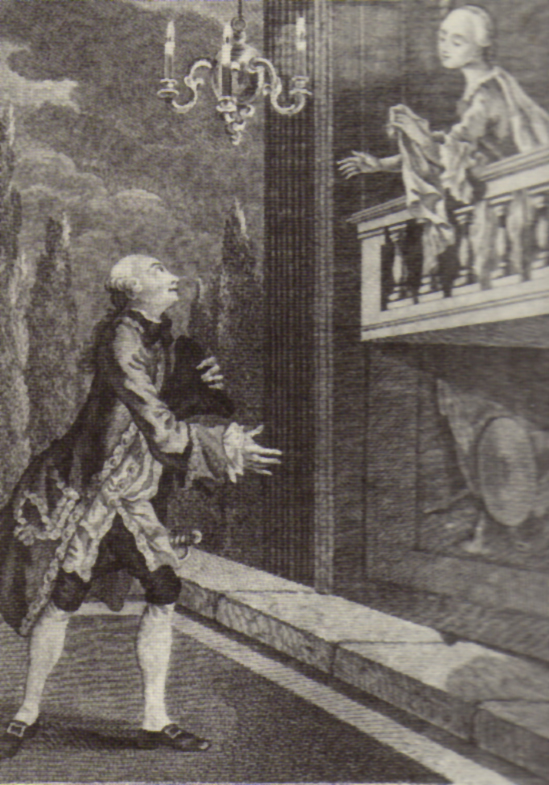
Nearly all the Barrys in the DIB - 37 pages of them - come from or are associated with Cork. The entry for Philip Barry (d. 1177) explains. The de Berris came from Wales and Philip was among the first Norman invaders in 1169. He failed to obtain enough of the spoils from storming Wexford, so headed over to Cork, where he succeeded in grabbing large estates and established a dynasty. One non-Corkonian I liked was Spranger Barry, a leading actor in Dublin and London (pictured here playing Romeo to his lover Maria Isabella Nossiter's Juliet). He was regarded as a serious rival to the great David Garrick and sufficiently successful to be buried in Westminster Abbey in London.

Tuesday, January 12, 2010

Athlètes maudits, hubristic painters and a damn fine cup of tea

There's something of the poète maudit about some Irish athletes. George Best, of course, one of the most talented football players of any generation, died aged 59 of multiple organ failure brought on by alcoholism. His famous quote "I spent a lot of money on booze, birds and fast cars. The rest I just squandered" is very funny, until you consider the price he paid. (Best isn't in the DIB yet, since he died in 2005, three years after the cutoff date for the print edition. He will be, I'm sure.) John Joe Barry, the "Ballincurry Hare", had more than a touch of the Best about him, alas. A middle distance runner of great ability - he held the world record at a mile and a half, and thrashed a world class field in a three mile race in Dublin - he blew his chances in the 1948 Olympics, in part at least because he hadn't trained hard enough, failed to make the 1952 team and retired before the 1956 Olympics, in which his countryman Ron Delaney won the 1500 metres gold. Drink, drugs and three unsuccessful marriages brought him down, alas. But he was an inspiration for those who followed him and avoided his mistakes - Delaney, Eamonn Coghlan and Sonia O'Sullivan among them.  (Yesterday, I failed to mention another great athlete, Edward Barrett, who won a gold medal for tug-of-war and a bronze for wresting at the 1908 Olympics and also had an all-Ireland senior hurling medal.)
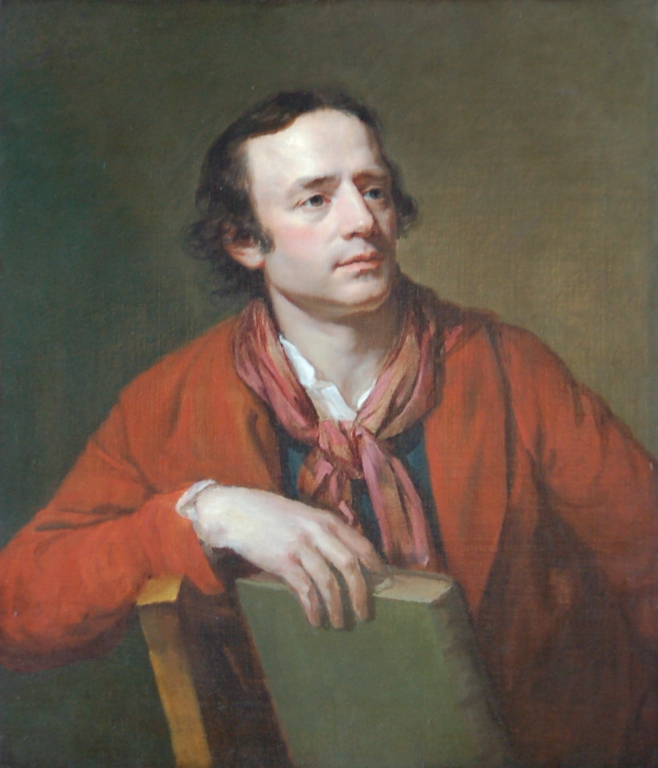
James Barry (not obviously related to John Joe but possibly distant kin - it's a Norman surname) also had self-destructive gifts. He engaged in ferocious disputes with his opponents - "real and imaginary" as the DIB puts it - which led to his being kicked out of the Royal Academy in Britain, "withdrawal from society" and descent into "increasing depths of introspection and alienation".  Perhaps unsurprisingly, he was drawn to portrayals of victims, such as the pictured Philoctetes on the Island of Lemnos, which hangs in the Pinacoteca Nazionale in Bologna. Philoctetes, alone, abandoned by his former comrades-in-arms and afflicted with a suppurating wound, suggests the artist's powerful identification with his theme. At the same time, the wounded subject has also been correlated with the condition of Ireland, and there's evidence that Barry saw things that way, as well. He combined mythology and actuality in so complex a way that it's challenging to peel away all the layers.


In his Portraits of Barry and Burke in the Characters of Ulysses and his Companion fleeing from the Cave of Polyphemus, which hangs in the Crawford Art Gallery in Cork, Barry portrays himself as the wily Odysseus - ironically the one who abandoned Philoctetes on Lemnos, making for a strange double-identificaiton on Barry's part - leaving the cave of the cyclops Polyphemus with his companion and friend Edmund Burke warning him against the hubris that in the original story brings down Poseidon's anger on Ulysses/Odysseus' head. It's a fascinating glimpse of someone who, like Ulysses, had prodigious talent but knew he couldn't constrain himself from exercising it without compromise. The DIB entry, a model of fact, background and appraisal, is by the art historian Peter Murray, who irrelevantly, also compiled a catalogue of the Dulwich Picture Gallery, which until recently was part of the same foundation as my old school.

Another James Barry, also from Cork, was a bird of a different feather. Barry's real name was probably Margaret, and she managed to pass as a man from at least the age of 17 until her death at 73 (she's on the left of the photo). Remarkably, she spent these years first as a medical student, then as an army and colonial doctor, in which role she pioneered hygeine standards, vaccination, limitations on the sale of prescription drugs, enlightened treatment of lepers, the caesarean section and much more. Like her painter namesake she partook in furious rows, including with Florence Nightingale, and fought at least one duel. One or two people may have known her secret, including her patron Lord Charles Somerset, who may have fathered her child and who was ironically accused of homosexuality because of the relationship. Her "true" gender was only revealed after her death in 1865, the same year as the "official" first woman in Britain to receive a medical degree, Elizabeth Garrett Anderson, graduated.

One more Barry. We islanders in America have one thing on which we're all agreed: it's really hard to get a good cup of tea here. The water is rarely boiled and the raw material is generally weak and insipid. The robust, heroic Irish tea is strong, masculine and contemptuous of the effete versions offered on this side of the Atlantic. Accordingly, we seek out obscure ethnic stores for the real thing, of which to me the locus classicus is that made by the great family firm Barry's of Cork. The founder of the firm, James J Barry, doesn't rate a DIB entry - for shame! - but his eldest son, Tony, does. Tony was said to be "one of the foremost tea tasters in these islands" and steered Barry's to the Empire Cup in 1934 (when we were still nominally part of the Empire). He really rates his entry because of his distinguished political career, which is all very well, but his true fame surely lies in bringing a great cup of tea to the breakfast tables or the world, including mine, daily.


Monday, January 11, 2010

Big House grandees, gentlemen adventurers and a pickpocket

I don't think I've ever met - or even heard of - a Barnewall. But there are 9 of them in the DIB, and following a bit of investigation, I've established, unsurprisingly, that they're all related. (Since the DIB only includes people felt to be significant, generations are skipped and genealogical dots not always connected - fair enough.) Different branches were endowed with a viscountship, barony and baronetcy (apparently, the baronetcy is still in existence). They were mostly called Patrick, Christopher and Nicholas, which also complicates identification. I found an Australian-based Patrick Barnewell on Facebook, but once you've seen his photo you'll understand why I decided not to check his bona fides. They're said to be Norman - Barneville, Berneville, Berneval and Barneval seem to be variants. They were once really big wheels, owned a lot of land in Meath, held major positions, were involved in big wars, prominent in parliament, and so on. And now they're gone: I checked the Irish phone book, and there are no Barnewalls listed today (suppose they could be ex-directory, but ...). There' s also a Harry Barniville in the DIB, a distinguished surgeon who became a senator in modern Ireland, and presumably distantly related to the others. I mentioned previously the issue of those who stayed and those who left after independence: for whatever reason - and it appears some of their lines died out - the Barnewalls moved on.

Maybe I'm unfair. Another "Big House" grandee who took off for Britain at independence had every reason to do so. Sir Charles Barrington is principally celebrated for having codified rugby in Ireland while a student at Trinity College Dublin. He lived a life not untypical of his class in late 19th and early 20th century Ireland - dabbled in local politics, provided administrative service - justice of the peace, high sheriff and so on - patronized the hospital founded by his grandfather, led the freemasons, and the like. In 1921, his daughter Winefred was shot dead by the IRA: she was travelling with the intended victim, a Black and Tans major named Henry Biggs; he survived the attack. The Barringtons had also been in Ireland a long time. The first baronet, Joseph, was born in Limerick in 1764. After the death of Winefred, Charles left for England and did not return. Even as he departed, he offered his home to the new Irish state as a residence for the governor-general: the generous offer was declined on cost grounds, and the house eventually became the site of a Benedictine community, Glenstal Abbey. The New York Times report of Winefred's death - is a compendium of the appalling bloodshed that took place at the time, just one killing among many. But it's still very poignant, a story of a family lost to us.


Alongside the sad stories today are plenty of remarkable characters. Richard Barrett was a campaigning journalist who managed to alienate pretty well everyone: the nationalist paper he edited, The Pilot was dubbed "a torpid viper which only awoke to inflict a wound". The author of that slur - a fellow-nationalist - was later denounced by him to the British authorities against whom Barrett had campaigned. We had John Asgill, the "eccentric writer" a few days ago. Today we have Jacky Barrett, the "eccentric scholar". A fellow of Trinity College Dublin and distinguished Hebrew scholar, it was said that he was so unworldly that he could not identify a sheep. Filthy and cheap, he had managed to save £80,000 - a colossal sum - by the time of his death in 1821. He left the money to "the hungry" and "the naked".

Then there was Charles Barrington - the epitome of the old-style gentleman adventurer. He was the first recorded climber to reach the summit of the Eiger in the Swiss Alps, in 1858 (pictured - it's been hard to find portraits today). He decided to do it as a lark, and took the route that the local experts expressly advised against. He was nearly caught in an avalanche on the way down, and went straight home to Ireland since he had run out of money. Later he trained the winning horse in the first Irish Grand National. Quite a man.


George Barrington - at last, a picture, albeit a bad one - was a celebrated 18th century pickpocket. He apparently started to provided funds for his otherwise impoverished travelling theatre company. He was finally caught stealing from the pictured Russian Count Orlov, but managed to talk his way out of a prosecution. When finally jailed for his crimes, he managed to obtain a pardon by attempting suicide and winning the sympathy of a "distinguished" visitor. He ended up, like so many, in New South Wales, where he obtained another partner by informing on his fellow prisoners and got a job as superintendant of convicts. (Interesting how many DIB subjects ended up in Australia on one or other side of the locked door - Barrington was unusual in finding himself on both sides.) He was ultimately declared insane.

We previously encountered Jonah Barrington in his comments on the bizarre Beauchamp Bagenal. He's famous for his Historic Memoirs of Ireland, but infamous for nearly everything else. As a judge - a political appointee with little obvious aptitude for the job - he misappropriated court fees. He pawned the family silver, the persuaded the pawnbroker to bring it over for a dinner party, got him drunk and absconded with it. He fled his creditors but was allowed, through his political connections, to keep his paid judgeship in Ireland. Eventually, in his 70s, he was removed from the bench by parliamentary action, apparently the only judge to have been so dismissed.


One more 18th century politician: Isaac Barré (worth including for the portrait alone), a huguenot who went into politics after a distinguished military career. It was an amazing era for Irish political oratory: Edmund Burke and Richard Brinsley Sheridan were so effective that at times they actually changed the minds of parliamentarians over major issues. Barré wasn't in their league but he was good enough to impress Hazlitt and Jeremy Bentham.

Sunday, January 10, 2010

A family of Balls, the father of mass-entertainment and the greatest of all the Barnacles

Mary Ball, yesterday's naturalist of the day, was part of a massive family business. Her brother, Robert, gave 7,000 specimens to the Dublin University Museum, whose zoological and ethnological collections he also organized. He also helped develop the Dublin Zoo. His eldest son, also Robert, was astronomer royal of Ireland and later director of Cambridge University's observatory (he's the one in the picture). The next son, Valentine, participated in the Indian geological survey before becoming director of the Institutions of Science and Art, an umbrellas for what are now the National Museum, National Library and botanical gardens. The third son, Charles, was an eminent surgeon who pioneered antiseptic operations and the rectal valves known as "Ball's valves". That makes five Ball family members with DIB entries - a sixth, Ann (or Anne), sister of Mary and Robert senior, is twice mentioned as herself being a noted naturalist.  Also, a grandson of Robert junior, Henry Barcroft, who held a chair of physiology at Queen's University, Belfast. A remarkable family.

One of the books I enjoyed reading at school was Balzac's Le Père Goriot. It is set in Paris in 1819 and opens in a boarding-house where some residents have a running joke of coining words with the suffix "-orama". Panoramas - large curved paintings viewed inside specially-constructed buildings - were popular entertainment at the time, hence the joke. The original panorama was invented by an Irishman, Robert Barker, who displayed landscape pictures inside a circular building, specially lit to create an illusion of reality. He was credited with using "a false perspective, a proper point of view, and unlimiting the bounds of the art of painting." Once his patent expired, the panorama became an international phenomenon. The DIB, reasonably, credits Barker with creating "an extremely popular form of mass entertainment which is the ancestor of many types of entertainment still current 200 years later," citing photography, cinema, IMAX and virtual reality games.

My birthday is June 16, or Bloomsday, the date on which James Joyce's Ulysses takes place and also when he met his wife Nora Barnacle. (I sometimes think Leopold Bloom is my closest living relative; apart from the June 16 thing, we both had Hungarian Jewish fathers and Irish catholic mothers. On the other hand, my father is alive and well, having never committed suicide in a hotel in Ennis.) Thanks to Brenda Maddox, we knew a lot already about Nora. She was an extraordinary companion to a very difficult though brilliant man. She had considerable character: she once told Joyce that if he didn't curb his drinking, she'd have their children baptized. Another story I like (although not in the DIB): Snobs considered her ill-educated and an unworthy consort for the great man. One such, during an interview, sought to trap her by asking who was her favorite writer. She replied, "when you've been married to the greatest writer in the world, you don't have much time for the little fellows." (I quote from memory.) I love that.

Saturday, January 9, 2010

Wanderings and resentments, kneelings and knockings, coercion and conciliation

Yesterday, we met Alfred Aylward, the Fenian whose global military career included a spell fighting with Garibaldi during his 1860 Sicilian campaign. Today, we have Thomas O'Malley Baines, a Fenian who fought against Garibaldi and his Sardinian allies in defense of the papal states. He believed that the upsurge of nationalism in Europe at this time had been orchestrated by the old Fenian enemy, the British (whose navy did, admittedly, help Garibaldi across the Straits of Messina after he conquered Sicily). Back in Ireland and Britain, he was arrested, imprisoned and transported to Australia, whence he departed for San Francisco, where he was active in working class and Fenian movements. Aylward had a taste for insurgency, Baines for nativism. These two elements have lived side by side in the Irish "physical force" tradition to this day, and are not easily reconciled. The DIB generally avoids editorializing, but the author of Baines' entry, Patrick Maume, is right to emphasize that "his career reflects the worldwide wanderings and resentments of many post-famine emigrants, the ambivalent relationship between nineteenth-century Irish nationalism and catholicism, and the fact that oppression does not automatically produce sympathy for other marginalized groups."

As a student, I read John Bale's King Johan (King John), considered to be important as the first English history play, albeit with an improbable premise: that Bad King John was a proto-protestant and hero of the struggle against the Whore of Babylon. Bale, a Carmelite friar turned married protestant priest had all of the classic zeal of the convert, which he exercised energetically when translated by King Edward VI to the see of Ossory, based at Kilkenny. The DIB doesn't mention King Johan (which it should) but it does touch on his autobiographical The vocacyon of Iohan Bale to the bishoprick of Ossorie in Irelande his persecucions in ye same, &; finall delyueraunce (1553), which is unsparing of the local religious scene when he reached Kilkenny:
In beholding the face and order of that city, I saw many abominable idolatries maintained by the priests for their worldly interests. The communion of the supper of the Lord was there altogether used like a popish mass with the old apish toys of antichrist, in bowings and beckonings, kneelings and knockings ...
Unsurprisingly, Bale didn't have a great time in Ireland, although it provoked much lively writing of this sort. When the news came that Edward VI has died, to be replaced by the Catholic Queen Mary, Bale describes how the priests of Kilkenny went on a pub crawl round the town, drinking "Rob Davie and Aqua Vitae" (I don't know what Rob Davie is) and toasting Bale's imminent departure.

My mother loved opera and thanks to her I love it too. At home, we had an edition of Kobbé's Complete Opera Book edited by the impresario the Earl of Harewood, apparently a cousin of Queen Elizabeth II. It really annoyed me that the section on 19th-century "English" opera included the Dubliner Michael William Balfe and the Wexford man William Vincent Wallace. (We'll give them Arthur "Gilbert and" Sullivan, since he was only the son of an Irishman. Julius Benedict, composer of the hit opera Lily of Killarney, based on Dion Boucicault's play The Colleen Bawn, was from Stuttgart but also co-opted by Kobbé/Harewood into the "English" section.) Balfe was a huge figure in his day, a very successful violinist and singer who went on to compose a string of big operas. The biggest of them all was The Bohemian Girl, from which the came the hit  I Dreamt That I Dwelt in Marble Halls. He also set the Tennyson lines Come Into the Garden, Maud for voice and piano - another key Victorian musical work. I've been nitpicking about odd omissions in DIB lives, but it's really inexplicable that the long Balfe life mentions neither song, although The Bohemian Girl is given its due.

Another heavyweight. Arthur James Balfour, the chief secretary of Ireland from 1887-91, a major step in his political ascension to the prime ministership. Balfour's Conservatives had taken over after Gladstone's liberals faltered and attempted a new Irish policy that still has considerable resonance. Balfour proposed a combination of "coercion" - cracking down hard on extra-parliamentary agitation, particularly over land issues - and "conciliation" - addressing the core concerns of Irish dissatisfaction - including land (again) and rural poverty. In Irish lore, he became "Bloody Balfour", after the deaths of three demonstrators at the hands of the police at Mitchelstown, Co. Cork in 1887. Balfour like other imperialists, believed that even limited home rule for Ireland would in time evolve into full separation from Britain, and that this would be but the first step in the disintegration of the British empire. In this, of course, he was quite correct. The "conciliation" aspect of the policy sought, by removing the fundamental grievances of the mass of Irish people, to neutralize devolutionary aspirations. The coercion/conciliation approach had considerable resonance a century later, during the more recent Troubles in Northern Ireland, where both approaches were attempted, often, as with Balfour, in tandem. Received wisdom, in Britain particularly, argues that the "peace process" triumphed in Ireland because "coercion" - particularly the penetration of the IRA by the British security services - convinced nationalism that a "military solution" could not be achieved, while "conciliation" drew the two communities into a shared political process that they could both embrace while defusing nationalism. The judgment of history on Balfour is accordingly, in a sense, a reflection of views on more recent events. The DIB's long Balfour entry has been written by the executive editor, James Quinn, which suggests that it had some importance for the enterprise. Quinn judges that the "coercion" part of Balfour's policy was quite effective in reducing agitation, which the "conciliation" strand was highly successful in some respects, less so in others. He concludes that "Balfour's record establishes him as one of the most effective chief secretaries during the union" It's certainly true that Ireland was not the graveyard of his career, as it was for so many politicians sent from London before and since. And in making his case, there's nothing aberrational about Quinn's position: nearly 40 years ago, the great F.S.L. Lyons described "Balfour's achievement" as "enough to rank him among the most successful Chief Secretaries", albeit not a "record of unmixed success". Interestingly, Balfour is not much discussed by those who might be exepected to echo this view - by R. F. Foster (Lyons' intellectual heir in some sense) in his Modern Ireland 1600-1972, or Paul Bew (these days identified with unionism) in Ireland: The Politics of Enmity 1789-2006, although Bew agrees that coercion was effective. The tide of opinion has not always run in this direction. In 1940, the Irish historian Nicholas Mansergh - who favored Ireland's remaining a self-governing dominion within the Commonwealth - described Balfour's policy as one of "miscalculation" and "failure". The major history of the conciliation/coercion period, by L. P. Curtis, Jr., points out that Balfour, in common with his fellow-Tories, completely failed to understand - or even acknowledge - the existence of genuine Irish nationalism that shaped the political process (a point echoed by Quinn in his entry). And yet another major Irish historian, J.J. Lee (in The Modernisation of Irish Society 1848-1948) is contemptuous of Balfour's coercion policy and his claim that he would introduce "repression as stern as Cromwell's." For Lee, coercion amounted to "little more than William O'Brien losing his pants in jail and three people losing their lives in Mitchelstown ... a derisory haul which must have left Cromwell turning in his desecrated grave." My point is not that the DIB entry is wrong; it's that some of the judgments, while of the mainstream, may nonetheless be contestable. You want an entry to take a view, not to be blandly factual; at the same time, you also want the richness of the historical debate to be reflected. The Balfour entry's very good, in fact: I'm saying this now in part to put down a marker for future discussion.

A couple of smaller entries: Edward Ball, the murderer, is given a nice piece. (He killed his rich mother when she refused to give him £60 to go on holiday.) It's an interesting story, but if there hadn't been a good book written about him (by the historian Richard Cobb) it hardly seems likely that he'd rate a place in the DIB. And my fondness of naturalists continues to grow: Mary Ball, a Cork woman, was the first to describe "stridulation" (making a sound by rubbing together legs or wings) in corixidae (water bugs); she had a mollusc and a seaweed named after her. An admirable life.


Adventurers, picaresque heroes and a great painter

The Irish turn up in a lot of places. The circumstances of Irish life from the mid-sixteenth century on, when the British consolidated their rule of the island, sent many off to continental Europe for education, soldiery or other adventure. The emergence of the British empire additionally created a paradoxical situation for the Irish: on the one hand, they were the subjects of empire, conquered, colonized and displaced; on the other, they were the agents of empire, enlisting in the imperial army or civil service, administering to other colonized peoples the same law that had been imposed on them. Subject or agent, they ended up all over the world.

William Aylmer, for instance. He started out, conventionally, in in 1794 as an officer of the Kildare militia, a servant of the British crown. Resigning his commission, he enlisted in the United Irishmen, and served as a colonel in the 1798 rising against British rule, for which he was banished following the defeat of the rebels. He then engaged in the Austrian army as a cavalry officer, fighting against Napoleon's armies. After a few years back in Ireland, he raised and commanded an Irish legion to fight in Simon Bolivar's rebellion agains the Spanish; he was severely wounded in 1820 in Venezuela, from which he was shipped to Jamaica, where he died.

Alfred Aylward, a 19th-century Wexford man, similarly slaked his revolutionary longings across the globe. Somehow, at the age of 17, having graduated from a Jesuit school in Co. Offaly, he found himself in Sicily, fighting alongside Garibaldi. He then went to America, where he spent four years as a suregon in the Union army during the civil war (his medical knowledge was apparently acquired in Guy's Hospital in London - when he was a patient). Upon his return to Ireland, he was jailed for suspected Fenianism, and upon his release went to South Africa, where he led an unsuccessful revolt of diamond diggers against the colonial administration. Later, he led the Lynchburg Volunteer Corp, a Boer-sponsored mercenary army that fought against the Marota king Sekhukhune. During the first Boer War, he fought for the Boers in Transvaal. Then he went to Canada, where he took part in Louis Riel's North-West Rebellion of Métis - descendants of marriages between indigenous and Europeans - against the domnion government. He died in an accident in New Hampshire a few years later. The facts alone are exhausting.

Pausing to mark the end of the As after 208 pages - Alexander Ayton, a Scottish photographer active in Derry in the late 19th century brings up the rear - we plunge back into the picaresque. Beauchamp Bagenal (I'm not making this up) left Cambridge without taking a degree and embarked on the 18th-century grand tour in grand style according to his near-contemporary Jonah Barrington:
He ... fought a prince, jilted a princess, intoxicated the doge of Venice, carried off a duchess from Madrid, scaled the walls of a convent in Italy, narrowly escaped the Inquisitiion at Lisobon, concluded his exploits by a celebrated fencing match at Paris; and returned to Ireland with a sovereign contempt for all continental men and manners and an inveterate antipathy to all despotic kings and arbitrary governments.
He was later MP for Enniscorthy; was there something about the place that attracted the crazies?

You could of course attempt a more conventional route. The flour mill builder John Bagwell from Clonmel shinned up the greasy pole of preferment, switching from presbyterianism to establishment anglicanism, suppressing rebels during the 1798 rising and backing the British line on the union of the two kingdoms in 1800 (bribery came into it). Having dutifully supported the government party as an MP, he sought a peerage, only to be turned down by the viceroy on the grounds that his "vulgar" nicknames - 'Old Bags' and 'Marshal Sacks' - denoted a "low man". Maybe the grand tour would have served him better.

For some reason, I always imagined that Waterford Crystal continued an ancient artisanal tradition, like Sheffield silverware. Wrong. There had been a crystal business in the city from the late 18th-century on, but it closed in 1851. The famous company we all know dates all the way back to 1947 when a Czech refugee, Charles Bačík, opened the original factory.   (I question the DIB's use of accents here: his name was generally written "Bacik" in Ireland, and I imagine that in Czechoslovakia [as it then was] he was Karel - his father's name - not Charles. For consistency, he should be Karel Bačík or Charles Bacik, but not the mishmash used by the dictionary.) Now that the Waterford Wedgwood company is in receivership and the Waterford factory closed down, it's sad to reflect that an institution so thoroughly associated with Ireland throughout the world was so short-lived.

Finally, an artist. Francis Bacon, Dublin born of English parents, never seemed in his lifetime to be strongly associated with Ireland: he left when he was 16 and doesn't appear to have returned often, although there was an exhibition of his work at the Hugh Lane gallery in 1965. Yet his lover John Edwards, the principal beneficiary of Bacon's will, bequeathed the contents of the artist's studio to the Hugh Lane, while the Irish Museum of Modern Art has exhibited works attributed to Bacon from the collection of another friend, Barry Joule. (The DIB doesn't mention these, nor the controversy that has raged over their authenticity.) So, whether Irish by conviction, or just anointed by his next of kin, Bacon has joined the pantheon of Irish lives, and we're delighted to have him.

Friday, January 8, 2010

The eccentric writer, the Gothic builder and the debonair disaster

It may be that the smuggest bumper sticker I ever saw was the one that read "In case of rapture, this car may be unmanned." (The link is to a website where you can buy it, along with "Bush/Cheney '04/Get Used To It!") It refers, of course, to the belief of certain Christians that at some time, certain believers will be physically translated into heaven - this is the Rapture - leaving the rest to deal with the Second Coming, Apocalypse and other sensational events. Well, it turns out that the Rapture has an Irish connection, sort of. John Asgill, both in 1659, was English, and a member of parliament. In 1700, he published An argument proving, that according to the covenant of eternal life ... man may be translated ... without passing through death, although ... Christ himself could not be thus translated till he has passed through death. Upon publication, he promptly moved to Ireland and engaged, unsuccessfully, in land speculation.  In 1703, he became member of the Irish parliament for Enniscorthy, Co. Wexford. On his first day in office, a vote was passed denouncing his book as "wicked and blasphemous"; it was ordered to be burned by the official hangman, the standard way of registering official anathematization of disfavored works. Two weeks later he was expelled from parliament and permanently banned from seeking re-election. He was later expelled from the English parliament, but apparently only partly for his religious views: he was also bankrupt. His profession is given in the DIB as "eccentric writer and politician". Jonathan Swift described his work as "trumpery". But the Rapture industry he helped to start keeps going, unabated.


William Ashford was another Englishman to try his luck in Ireland, where he became a successful and prolific artist. He toured the country for his job inspecting armaments stored in forts and barracks, and started recording the landscape, as in this French-inflected rendition of a scene in Co. Kildare. He was first president of the Royal Hibernian Academy. George Coppinger Ashlin, an architect went further and shaped the landscape. Following Catholic emancipation in 1829, there was an explosion in church building across the country, a movement that attracted many artists and artisans from inside and outside Ireland (including the English stonemason father of the revolutionary Patrick Pearse). Ashlin was born in Cork, but educated in Belgium and England, where he as apprenticed to to the architect Edward Welby Pugin, son of the pioneer of the Gothic revival, Augustus W. N Pugin. Pugin and Ashlin were responsible for a large number of Gothic-style Catholic churches in Ireland, such as the beautiful St Colman's cathedral in Cobh, Co. Cork (pictured).


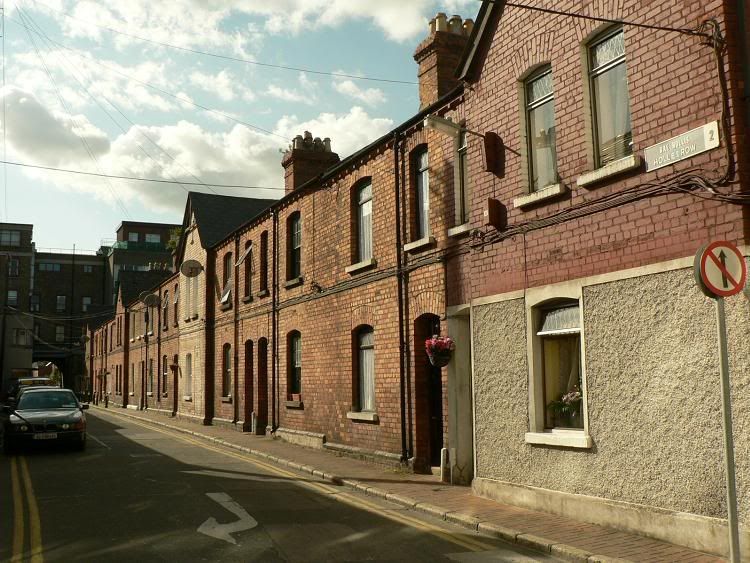
On a less heavenly scale, but arguably as significant, the English architect Charles Herbert Ashworth designed houses in the late 19th century for the Dublin Artisans' Dwelling Company, which attempted to provide low-cost housing for the working classes as a small corrective to the hideous slums - said to be among the worst in Europe - in which so many lived. The DIB says "he gave meticulous attention to the smallest details of design, construction and maintenance", which may be true given that so many are still standing, such as these in Holles Row in central Dublin, a stone's throw from Trinity College. The condition of the urban poor preoccupied many; remarkable that in a few pages of of each other in the DIB one finds Ashworth, the philanthropist Sarah Atkinson, who founded schools and hospitals around the city in the nineteenth century, and Ernest Aston, a journalist and town planner who championed improved housing for the working classes while denouncing "mediocrity and procrastination". There was - and still is - much of it about.


So often, the official British in Ireland seemed out-of-place to virtually anybody, regardless of community. Humphrey Atkins was the first of five Secretaries of State for Northern Ireland in the eleven years during which Margaret Thatcher was the British prime minister. He had an almost absurd colonial pedigree - his coffee planter father was killed by a rhinoceros in Kenya - and spent most of his life in politics following naval service and a brief stint as a linoleum executive.  When he was parachuted into Ireland - the intended Secretary, Airey Neave, having been murdered by the Irish National Liberation Army shortly before Thatcher's election in 1979 - he knew next to nothing about it, and didn't pick up much on the job. I largely observed the Troubles from England in the 1970s and 1980s, and was constantly dismayed how London governments, Labour and Conservative, managed to send successions of nobodies to take on a titanically difficult job: Merlyn Rees, Roy Mason, Humphrey Atkins, Tom King, Peter Brooke ... all dreadful. Atkins was one of the worst. Maurice Hayes, one of the very few Catholic high-flyers in the Northern Ireland civil service, called him "totally invisible and lazy" and "a disaster." The IRA hunger strikes, during which 10 prisoners starved themselves to death, occurred on his watch. Atkins was a hardline supporter of the Thatcher government's hardline stance over the strikes, which alienated and radicalized even moderate Catholic opinion and caused damage that took years to repair. He returned to London to even higher office, in which he was equally ineffective: he assured parliament in April 1982 that Argentina had not invaded the Falkland Islands. Unfortunately, it had. His resignation was followed by the inevitable rewards of knighthood and enoblement, although the DIB suggests he "continued to display his phlegmatic and debonair mien." I think that means this.